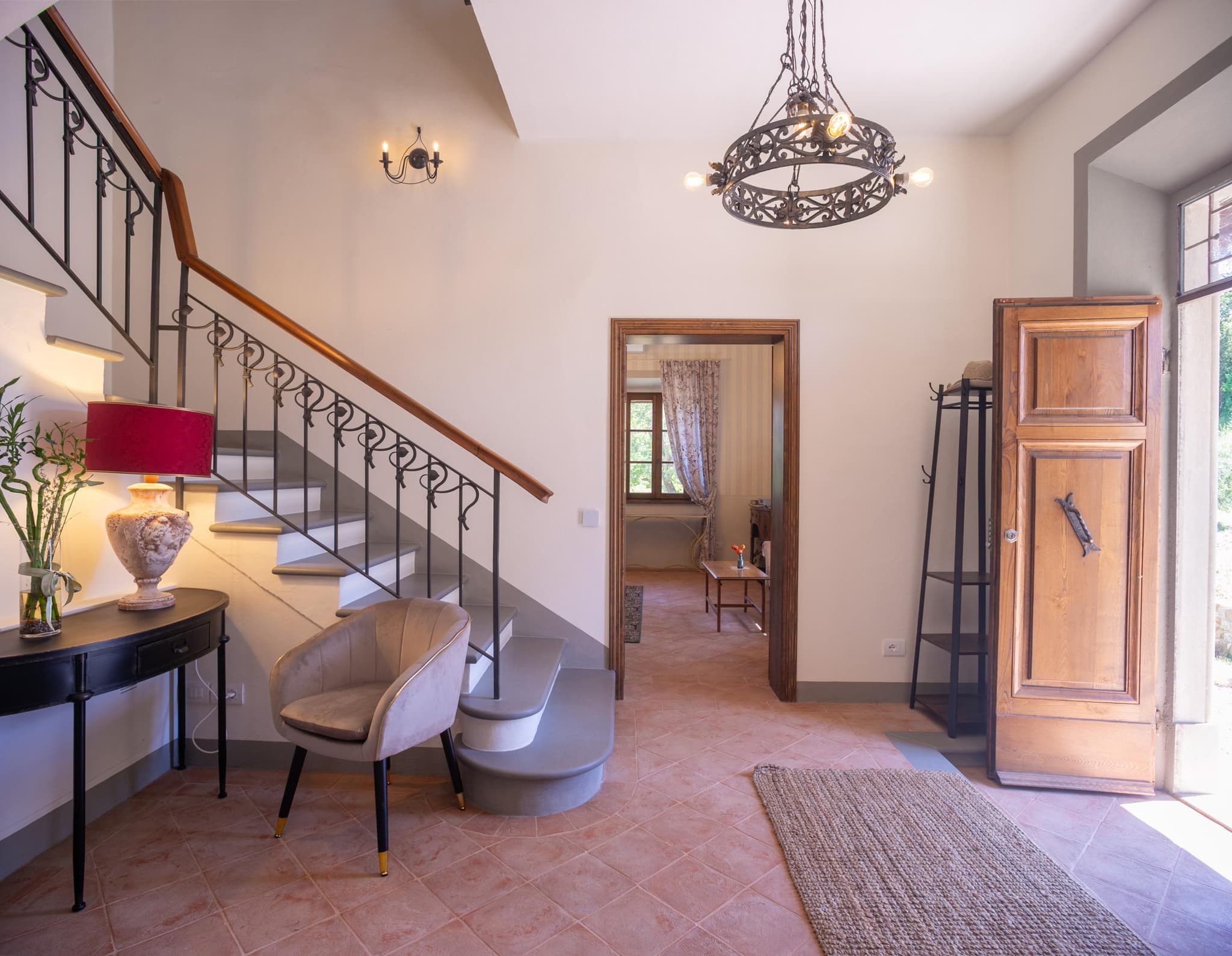
“Layers of twentieth-century cement were chipped away by hand to reveal the original pietra serena beneath - grey Tuscan sandstone, quarried from the same hills since the Etruscans.”
In the hills above Radda in Chianti, at 530 metres, a seventeenth-century villa sat beneath layers of modern addition. Cement render covered the original stonework. Suspended ceilings hid the chestnut beams. The cantina, carved from the rock beneath the house, had been sealed and half-forgotten. The restoration of Le Rondini was not renovation. It was archaeology.
The work began with the walls. Layers of twentieth-century cement were chipped away by hand to reveal the original pietra serena beneath: grey Tuscan sandstone, quarried from the hills around Fiesole and Settignano, the same stone Brunelleschi used for the columns of Santo Spirito. Each block was cleaned, repaired where necessary, and left exposed. There is nothing to improve upon in a material that has aged gracefully for four centuries.
Pietra Serena, Cotto, and Chestnut
The floors are handmade cotto - terracotta tiles formed in wooden moulds, dried in the Tuscan sun, and fired in wood-burning kilns. Each tile carries slight variations in colour and texture, the fingerprint of the artisan who shaped it. No two are identical. The warmth underfoot on an afternoon when the sun has crossed the room is a warmth that machine-made tiles cannot hold.
The ceiling beams are chestnut - castagno - the traditional wood of these hills, prized because it resists insects and rot without treatment. The beams that hold this roof were felled, hewn, and placed centuries ago. They were cleaned and strengthened during the restoration. Never replaced. The marks of the original carpenter's adze are still visible if you look closely enough.
In La Cantina, the arched stone ceilings still carry voices as they have since the villa was a working estate. The original hollow where grapes were delivered from the fields above is still visible - a window carved in stone into a way of life that has not entirely disappeared.
Radda Through the Ages
The villa does not exist in isolation. It sits within the story of Radda itself - a village that first appears in the written record in 1003, in an edict of Emperor Otto III. For over five centuries, Radda served as the capital of the Lega del Chianti, the Florentine alliance that governed these hills. The Palazzo del Podesta, a fifteenth-century stone building, still dominates the main square, its facade layered with the heraldic shields of successive governors.
The town's medieval defensive walls remain visible in sections - embedded in houses, supporting garden terraces, silent witnesses to the centuries when these hills were contested ground between Florence and Siena. The Church of San Niccolo, thirteenth century, carries the scars of Allied bombing in 1944. History here is not a museum exhibit. It is the fabric of daily life.
Historic photographs of Radda capture a village that has changed remarkably little. The stone facades, the narrow streets, the cypress-lined approaches - they are recognisable across a century of images. The spirit of the place persists because the materials persist: stone, terracotta, chestnut, iron. Nothing was built to be temporary.
Leo Lionni's Radda
Three kilometres from Le Rondini, up a gravel road that narrows between stone walls until the asphalt gives up entirely, lies the hamlet of Porcignano. In the 1960s, Leo Lionni - Dutch-born, American-raised, one of the most celebrated illustrators of the twentieth century - left New York and settled here. He was already famous: art director of Fortune magazine, design consultant to Olivetti, inducted into the Art Directors Hall of Fame in 1974.
It was here, among the olive groves and vine rows of Radda, that Lionni created the books that defined a generation of children's literature. Frederick, the mouse who gathered sunlight and colours instead of grain. Swimmy, the small fish who saw differently. Four Caldecott Honor titles, each a meditation on individuality, community, and the courage of seeing what others overlook.
Lionni left sculptures in the landscape around Porcignano - works placed among trees and stone walls, still visible today on a walking trail that winds through the hamlet. He lived in Radda until his death on 11 October 1999, at the age of eighty-nine. The hills he chose are unchanged. The light he painted by is the same light that falls on the terrace of Le Rondini every afternoon.
Every Stone Has Been Earned
The restoration of Le Rondini was guided by a single principle: reveal what was already there. The watchtower, built in the sixteen hundreds to see armies coming over the ridge, now watches only sunsets. The thick walls - three feet in places - hold the same cool silence they held four centuries ago. The cantina, reopened and restored, hosts tastings and candlelit dinners where the acoustics are as old as the stone.
Nothing was invented from scratch. The materials are local: pietra serena from the Tuscan hills, cotto from traditional kilns, chestnut from the forests that surround the property. The craftsmanship is patient, specific to this place, and intended to last another four centuries. Every stone in this house has been earned - by time, by weather, by the hands that shaped and reshaped it across the generations.