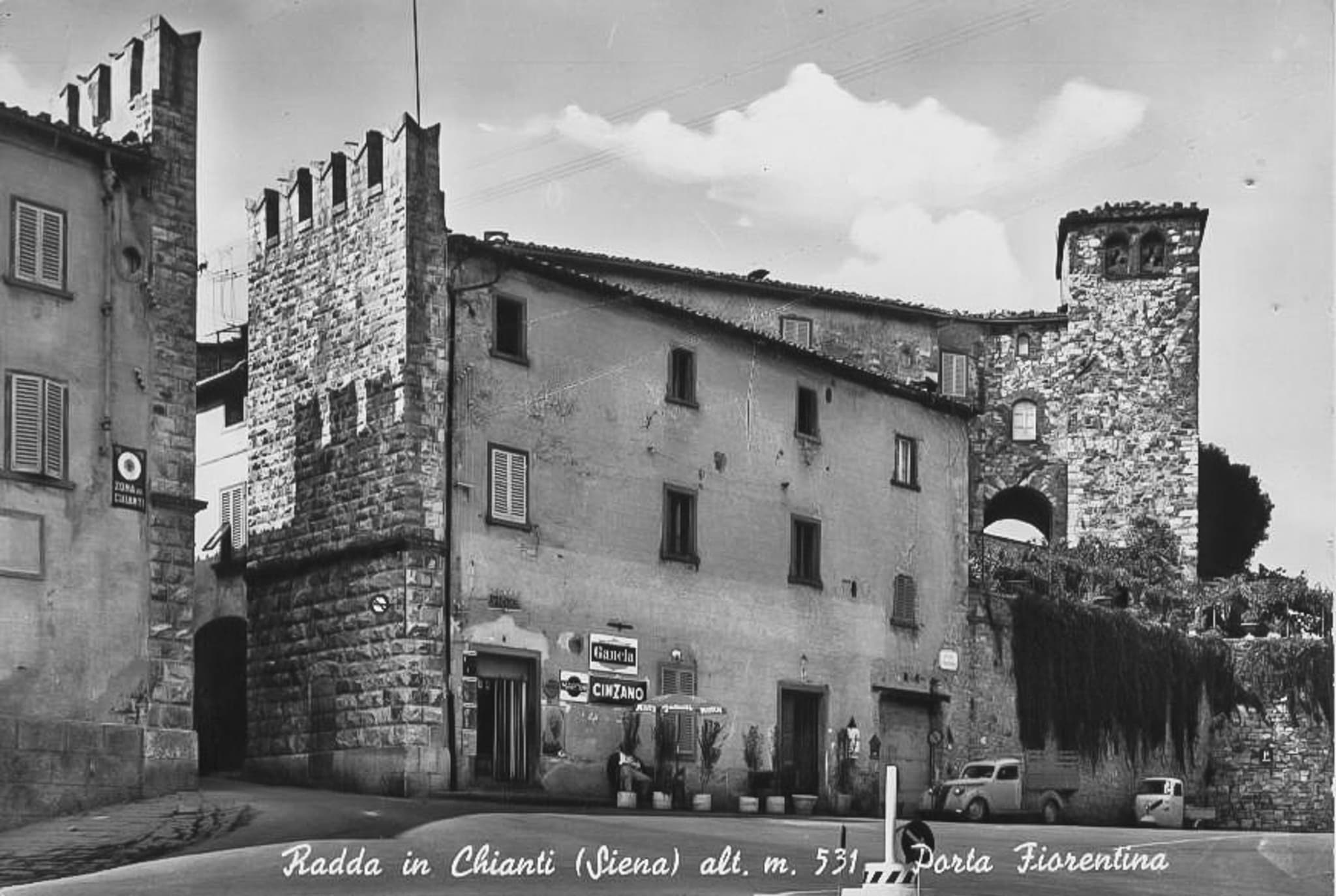
“An artist of international stature - art director of Fortune, consultant to Olivetti, four Caldecott Honors - chose to spend his final decades on a hillside in Radda in Chianti. The question is not why he came. It is why anyone would leave.”
Three kilometres from Le Rondini, up a gravel road that narrows between stone walls and olive groves until the asphalt gives up entirely, lies Porcignano. It is a hamlet in the true sense - a cluster of stone houses, a few restored, most quietly ageing, perched on a hillside that overlooks the same valley you see from our terrace. In the 1960s, a man arrived here who would become one of the most celebrated illustrators and designers of the twentieth century. He stayed for the rest of his life.
Leo Lionni was born in Amsterdam on 5 May 1910, to a Dutch-Jewish family. His childhood home hung with paintings - his uncle was a collector of Flemish masters - and the boy drew constantly, copying the works on the walls before he could properly spell the artists' names. By his twenties, he had moved to Italy, studied economics in Genoa, begun painting seriously, and joined the Italian Futurist movement. When Mussolini's racial laws made Italy dangerous for Jewish families, Lionni emigrated to the United States in 1939.
In America, his career became extraordinary. He was appointed art director of Fortune magazine, where he transformed the visual language of business journalism. He consulted for Olivetti, the Italian typewriter and technology company, bringing a European sensibility to corporate design. In 1955, he created the first issue of Print magazine's Annual. In 1974, he was inducted into the Art Directors Hall of Fame. In 1984, the American Institute of Graphic Arts awarded him its gold medal - the highest honour in the field.
From Fortune Magazine to Children's Literature
But it was a story told to his grandchildren on a commuter train that changed everything. In 1959, bored and trying to entertain two restless children during a train journey, Lionni tore coloured pages from a magazine and improvised a story about two worms. That story became Little Blue and Little Yellow, his first children's book, and it announced a new way of making picture books - abstract, philosophical, deeply respectful of the child's intelligence.
The books that followed are among the most celebrated in children's literature. Swimmy, published in 1963, tells the story of a small black fish who organises a school of red fish to swim in formation as one giant fish, defeating the tuna who prey on them. Inch by Inch, published in 1960, follows an inchworm who saves himself from hungry birds by demonstrating his ability to measure anything - the robin's tail, the flamingo's neck, the heron's leg - until asked to measure the nightingale's song, whereupon he inches away into the grass. Frederick, published in 1967, is about a field mouse who gathers sunlight, colours, and words while his family stores grain for winter - and when the food runs out and the days are grey, Frederick feeds them poetry instead.
Four Caldecott Honor titles. Each one a meditation on perception, community, and the courage of seeing what others overlook. These are not simple children's stories. They are parables - as compressed and deliberate as any fable by Aesop, as visually rigorous as any work Lionni produced for Fortune or Olivetti.
Why Porcignano? An Artist Chooses Radda
It was after this artistic peak that Lionni returned to Italy and chose Radda. Not Rome. Not Florence. Not Milan. Porcignano - a hamlet so small it barely appears on maps, where the mail arrives late and the nearest town with a proper bar is a fifteen-minute drive down a winding road. He settled in a stone house with a garden that opened onto the same hills that Chianti winemakers had cultivated for centuries.
Why Porcignano? Perhaps because an artist who spent his career distilling complex ideas into simple, perfect images understood the value of a landscape that did the same. The Chianti hills are not dramatic. They do not shout. They offer a composition - vine, olive, cypress, stone - that has remained essentially unchanged for a thousand years, and they trust you to see what is there.
Lionni spent three decades in Radda. He continued to paint, to sculpt, to write. He left sculptures in the landscape around Porcignano - works placed among the trees and stone walls, still visible today on a walking trail that winds through the hamlet. These are not gallery pieces transplanted to the countryside. They are works conceived for this specific place, responding to the light, the stone, the particular quality of silence that settles on these hills in the late afternoon.
A Legacy in the Landscape
He died on 11 October 1999 in Siena, at the age of eighty-nine. He is buried in Radda. The hills around Porcignano are unchanged since he walked them - the same olive groves silvering in the afternoon light, the same vine rows climbing the terraces, the same view of the valley where the sunset turns everything to gold before it disappears.
There is a particular kind of tribute in this: that an artist whose entire body of work was about seeing - really seeing, not just looking - chose this hillside as the place where he would do his seeing. Leo Lionni could have lived anywhere in the world. He chose Radda in Chianti. The light that fell on his studio is the same light that falls on your terrace every afternoon. The silence he worked in is the same silence you hear when the cicadas pause and the valley holds its breath between gusts of warm wind.
His books remain in print in dozens of languages. Frederick, the mouse who gathered sunlight, is read to children who will never visit Radda. But the sunlight Frederick collected - the warmth, the colour, the particular gold of a Tuscan afternoon - that came from here. From these hills. From the same sky you see when you step outside.